
That Buffalo Thing – About Connection and Awareness
That Buffalo Thing – About Connection and Awareness
 I was at a Fabindia store this morning. A young Indian professional — well-dressed, confident, probably in his early 30s — walked in with an overseas guest. Probably he was tasked by his office to take the guest around for some shopping.
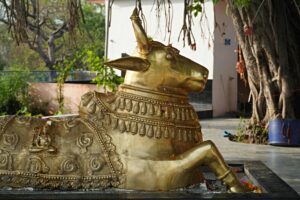
The guest smiled and said, “I want to buy a Nandi.” The young man replied, “You mean that buffalo thing, is it?”
And in that tiny exchange, something inside me paused.
It wasn’t about language. It was about awareness.
Nandi — the sacred bull of Lord Shiva — isn’t just a “buffalo thing.”
It’s a centuries-old symbol of devotion, strength, and calm focus.
The foreign guest seemed curious, respectful, even reverent.
But the Indian — the one representing India — didn’t seem to know what he was talking about.
To the guest, Nandi was a piece of India’s soul.
To the young man, it was “that buffalo thing.”
No arrogance. No rudeness.
Just… a quiet disconnection.
That moment made me think.
 Are we, as modern Indians, losing touch with the roots that make us who we are?
We can debate global economics, code in Python, and discuss AI ethics…
but sometimes struggle to explain the story behind a Nandi, a Warli painting, or a piece of handloom fabric.
I don’t share this to judge him — I share it because it made me think.
How often do we, as Indians, underplay the richness of our own culture?
How often do we rush past the stories, the symbols, the meanings that make India… India?
We’ve learned to compete.
But have we forgotten to connect?
The Paradox of the Global Indian
 Our youth today are brilliant — educated, articulate, globally mobile.
They can explain artificial intelligence and climate change with ease.
But ask them about the story behind a Warli painting, a handwoven ikat, or a Nandi — and there’s silence.
It’s not because they don’t care. It’s because we stopped teaching pride without politics.
We told our next generation how to be competitive, but not how to be connected.
National pride today need not wear a flag on its sleeve. It simply needs mindfulness — to know where we come from, to represent it with authenticity, and to speak of it with dignity.
The young man at Fabindia may not have meant any harm. But his casual words mirror a deeper gap that we, as a society, must bridge — a gap between heritage and habit.
Let us remind ourselves that cultural pride is not about the past alone; it is about carrying our stories forward with grace, humility, and confidence.
When someone from another culture asks about something Indian, it’s not just curiosity.
It’s an invitation — to share, to educate, to represent.
Imagine if that young man had said: “Ah, Nandi! It’s the sacred bull — a symbol of devotion and patience. Let’s find one that captures that spirit.”
That one sentence could have turned a shopping errand into a moment of cultural connection.
Taking Pride in the Small Things
 Cultural pride isn’t loud. It’s quiet, humble, lived. It shows up when:
- You tell someone the story behind what they admire.
- You buy from local artisans because you value their skill.
- You speak your mother tongue without apology.
- You know why your festivals matter beyond the holidays they bring.
Pride isn’t about politics — it’s about presence. It’s about being aware of what we carry as Indians, and representing it with grace.
Pride isn’t about just waving flags.
It’s about remembering who we are when no one’s watching.
What I Took Away from That Moment
Global respect begins with self-respect.
If we don’t value our own heritage, how can we expect others to?
 Next time someone asks, “What’s a Nandi?”
Let’s not say, “That buffalo thing.”
Let’s say, “It’s a symbol of strength and devotion — a part of what makes India, India.”
Because every story we tell is a thread in the fabric of national pride. And because every time we tell our stories, India grows a little stronger.
What does cultural pride mean to you — and how do you express it in your everyday life?
I’d love to hear your thoughts.